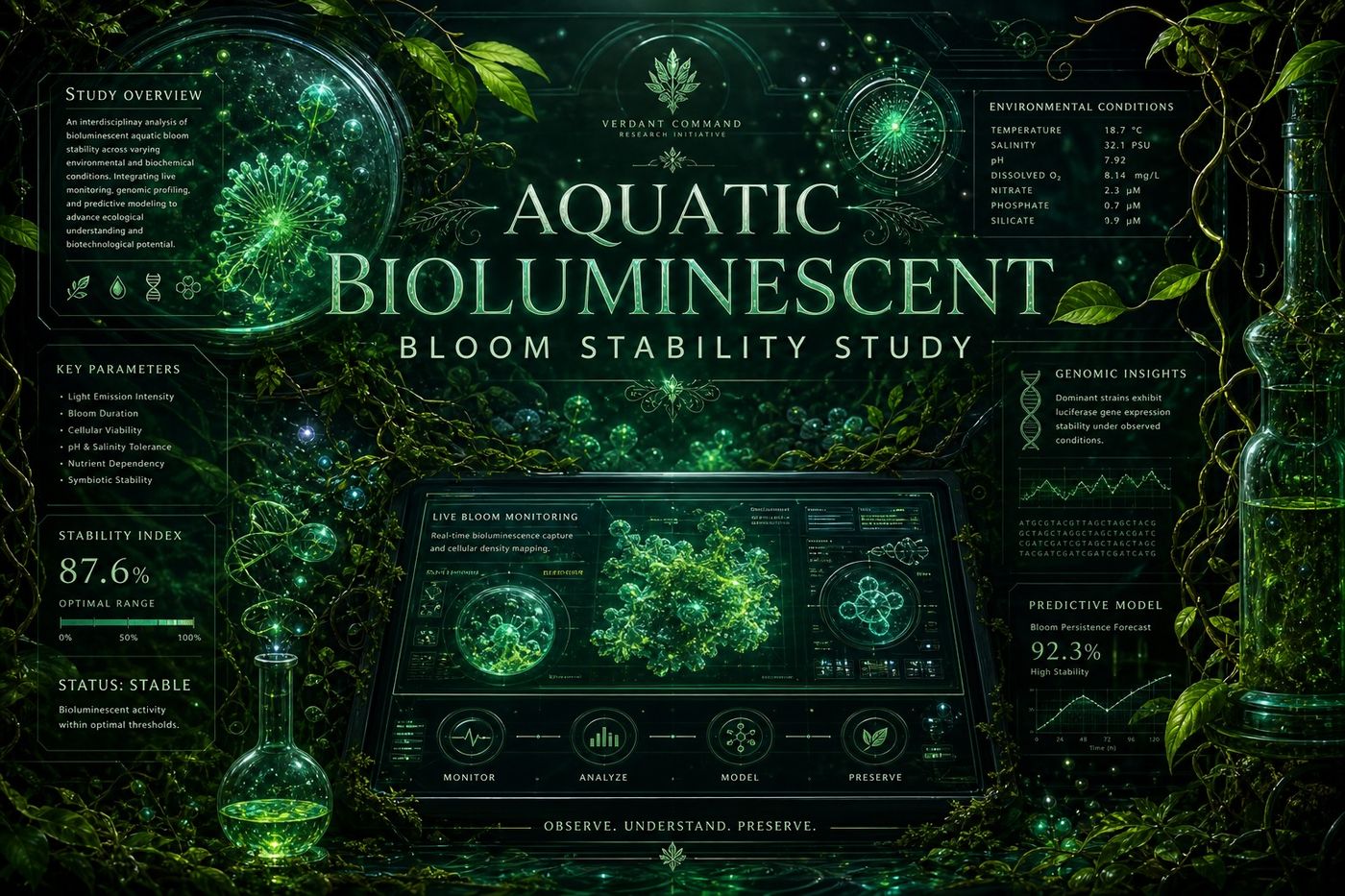
Aquatic Bioluminescent Bloom Stability Study
RL-2091-031 — sustaining luminance and cell density of a suspended bioluminescent consortium in the Tidal Sphere without runaway bloom, crash, or quorum-driven oscillation.
Objective
Hold the suspended consortium at a stable luminance of ≥ 2.8 cd·m⁻² (agitation-triggered) and a cell density inside a ±10% band for ≥ 30 days, with no bloom excursion above the crash threshold and no dark-phase oscillation exceeding ±15%. Findings cross-feed the terrestrial yield work in RL-2091-014 and the aquatic vitality metrics.
Hypothesis
Bloom instability in suspension is driven by a nutrient–quorum feedback loop: a nitrate pulse drives a density bloom, the bloom self-shades and crashes, and the crash releases nutrients that seed the next bloom — a sawtooth. We hypothesize that continuous low-rate nutrient dosing under closed-loop turbidity control will damp the oscillation into a stable plateau, and that gentle continuous agitation will hold luminance without exhausting the cells' light-debt reserve.
Method
- Vessel: Tank T-4, 1,200 L, Tidal Sphere; temperature 19.5 °C, salinity 34 PSU, 12 h/12 h photoperiod.
- Two control modes: Pulse (legacy nitrate bolus every 48 h) vs Continuous (CHLORA turbidity-locked drip).
- Cell density by inline turbidity + daily haemocytometer check; luminance by submerged photometer on a standardized agitation pulse, 5-min cadence.
- Dissolved O₂, nitrate, and pH logged continuously to the Mycelial Data Fabric.
- Crash threshold pre-defined: density > 1.8× setpoint flags imminent self-shade collapse and auto-throttles dosing.
- Run length 45 days; cutover from Pulse to Continuous at day 14.
Bench Entries
Consortium seeded at 1.2×10⁶ cells·mL⁻¹. Legacy Pulse mode for baseline. First 48 h textbook sawtooth: nitrate bolus → density climbs to 2.1×10⁶ → self-shades → luminance halves overnight. The tank glows beautifully then sulks. The instability hypothesis is visible to the naked eye on night one.
Setback during baseline. A Pulse bolus coincided with a warm-side temperature drift (+1.3 °C from a Tidal Sphere chiller hiccup) and the bloom overshot to 2.3×10⁶ — tripped the crash threshold at 03:40, density collapsed 44% by morning, luminance to 0.9 cd·m⁻². No containment concern (GCL-1) but a clean demonstration of how little it takes to tip the Pulse regime. Chiller fault logged to Engineering. Bringing the Continuous cutover forward.
Continuous turbidity-locked dosing, day 22. The sawtooth is gone. Density holding 1.95×10⁶ ±6%, luminance 2.9 cd·m⁻² on the standard agitation pulse, dark-phase oscillation down to ±9%. Nitrate sits flat at 0.4 mg·L⁻¹ instead of spiking. Hypothesis holding — continuous dosing damps the loop exactly as predicted. Dissolved O₂ stable.
Day 33 — primary stability objective met. 30-day window closed with density inside ±7% and luminance 2.8–3.0 cd·m⁻². One curiosity: a faint ~26 h luminance rhythm persists, decoupled from the 24 h photoperiod — likely an endogenous circadian remnant in P. lucifer. Harmless, but noting it; the cells keep their own time.
Extended run, day 45. Stable plateau intact: luminance 2.9 cd·m⁻² ±0.1, density ±7%. No crash, no overshoot since the chiller fix. Continuous control is the answer. The 26 h endogenous rhythm is robust and now characterized. Drafting interim report; continuing the tank as a standing demonstrator.
Interim Findings
The nutrient–quorum sawtooth is confirmed as the instability driver, and CHLORA turbidity-locked continuous dosing eliminates it, holding the consortium on a stable luminance plateau through a 45-day run — comfortably inside all three objectives. A secondary finding: an endogenous ~26 h circadian rhythm in P. lucifer persists independent of the imposed 24 h photoperiod, a benign but notable trait for any future free-running aquatic display.
Next Steps
- Promote CHLORA turbidity-locked continuous dosing as the standard aquatic bloom-control mode.
- Coordinate with Engineering on Tidal Sphere chiller stability — the regime is sensitive to >1 °C drift.
- Feed the suspension precursor kinetics back to RL-2091-014 for the cross-substrate comparison.
- Open a sub-note characterizing the 26 h endogenous rhythm for free-running display feasibility.
References
- Botanical Metrics Library
- VC-MET-001 — Canopy Vitality Index (vitality framing)
- VC-SOP-0201 — Cultivation Cycle
- Specimen Archive — Pyrocystis lucifer consortium record
- Related log: RL-2091-014 — Bioluminescence Yield Optimization