Bioluminescence Yield Optimization in Engineered Cultivars
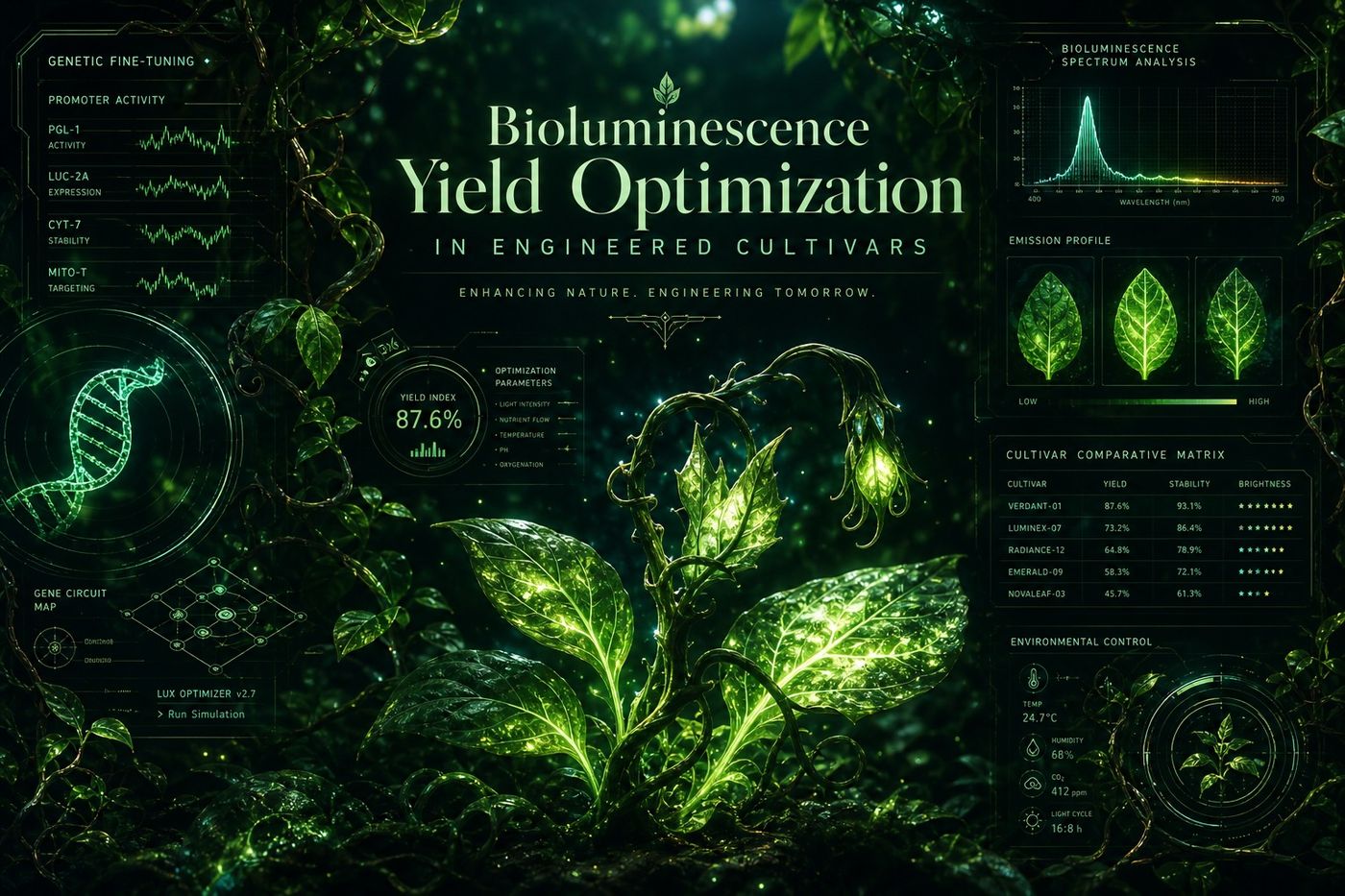
RL-2091-014 — a study to raise sustained photon flux from the engineered Lux pallida cultivar line without compromising canopy vitality, by tuning the luciferin precursor supply and the photoperiod light-debt cycle.
Objective
Increase mean sustained luminance of the Lux pallida cv. 'Nyx' bench from a baseline of 2.1 cd·m⁻² to a target of ≥ 3.4 cd·m⁻² across a full 12-hour dark phase, while holding Canopy Vitality Index (CVI, VC-MET-001) ≥ 92 and keeping luminance decay across the dark phase below 15%. Secondary objective: characterize the precursor-supply ceiling beyond which photon output saturates or becomes phytotoxic.
Hypothesis
Photon yield in the 'Nyx' line is precursor-limited, not enzyme-limited. We hypothesize that supplementing the substrate with a buffered luciferin-analog feed during the light phase will build a precursor reserve that sustains higher luminance through the dark phase, and that a brief pre-dark "light-debt" interval (far-red enrichment) will further synchronize the emission onset. We predict a dose-dependent luminance gain up to a saturation point near 0.8 mM feed concentration, beyond which CVI will decline as the analog competes with native chlorophyll metabolism.
Method
- Subject bench: 48 Lux pallida cv. 'Nyx' specimens, Sphere Cluster L, Bench A-7, age-matched at 90 days post-vitro.
- Four feed arms, 12 specimens each: Control (0 mM), Low (0.4 mM), Mid (0.8 mM), High (1.6 mM) buffered luciferin-analog, delivered via fertigation during the 12 h light phase.
- Photoperiod: 12 h light / 12 h dark; far-red light-debt pulse (730 nm, 8 min) applied 10 min before dark onset to the treatment arms.
- Luminance read by calibrated photometer array, 5-min cadence, against facility metrics; CVI logged per VC-MET-001.
- Cultivation set-points held per VC-SOP-0201 Cultivation Cycle. No deviation without logged entry.
- Run length: 28 days. Decision gate at day 14.
Bench Entries
Bench established. All 48 specimens at baseline luminance 2.0–2.2 cd·m⁻², CVI 96.4 facility-aggregate. Feed lines primed and flushed; analog stock assayed at 99.1% purity. Arms randomized by CHLORA. Dark-phase baseline emission decays 22% over 12 h — that decay is the number to beat. Begin treatment on the 03-05 light phase.
Day 7. Clear dose response. Mid arm (0.8 mM) holding 2.9 cd·m⁻² at hour 6 of dark, decay down to 11%. Low arm modest (+9%). High arm (1.6 mM) brighter at onset — peak 3.6 cd·m⁻² — but fading hard, 19% decay, and two specimens showing marginal chlorosis. CVI: Control 96.1, Mid 95.7, High 90.8 and trending down. The High arm is buying brightness with health. Note for the record: brilliance that consumes its host is not yield, it is theft.
Setback. High-arm CVI tripped WARN overnight (79.4, stress-override cap engaged per VC-MET-001) on specimens H-04 and H-09 — necrotic flecking at leaf margins, the analog is out-competing native metabolism exactly as hypothesized at the ceiling. Pulled both to quarantine, logged a Specimen Archive condition note. High arm is a confirmed dead end above 0.8 mM. No safety event; containment nominal (GCL-1). Redirecting High-arm survivors to a 0.8 mM step-down to test recoverability.
Day 14 decision gate. Mid arm is the winner and then some. Sustained luminance 3.5 cd·m⁻² at hour 6, 3.1 cd·m⁻² at hour 12 — decay 11.4%, well inside the 15% objective. CVI 95.9, untouched. Stepped-down High survivors recovered to CVI 93.2 over 9 days, confirming the damage was metabolic competition, not permanent. Far-red light-debt pulse contributes a measurable +0.2 cd·m⁻² onset synchrony — small but free. Gate passed: continue Mid arm, drop High arm, extend Low arm to 0.6 mM.
Steady state. Mid arm (0.8 mM) holding 3.5 cd·m⁻² mean across the full dark phase, 28-day stability ±0.08 cd·m⁻². The bench reads like a field of cold green stars and the instruments agree. CVI 96.0. Objective met. Drafting the cultivar amendment for the 'Nyx' line. This is releasable internally; it is not releasable.
Interim Findings
The yield ceiling is precursor-supply driven and saturates at 0.8 mM buffered analog; above that, photon gain is illusory and bought at the cost of host vitality (CVI breach at 1.6 mM). The 0.8 mM Mid arm meets both luminance and decay objectives at no measurable CVI cost. Far-red light-debt synchrony is a minor positive. The hypothesis — precursor-limited, not enzyme-limited — is confirmed with the qualification that the precursor ceiling and the phytotoxic ceiling are uncomfortably close (factor of ~2).
Next Steps
- Issue cultivar amendment promoting the 0.8 mM fertigation feed to the standard 'Nyx' protocol.
- Open a sub-study on a slow-release analog matrix to widen the precursor/phytotoxic margin beyond 2×.
- Cross-reference aquatic-substrate behaviour with RL-2091-031 (Aquatic Bloom Stability) — precursor kinetics may differ in suspension.
- Tag the necrotic-flecking failure mode in the High-arm specimens to the Specimen Archive for cross-study reference.
References
- VC-MET-001 — Canopy Vitality Index
- Botanical Metrics Library
- VC-SOP-0201 — Cultivation Cycle
- Specimen Archive — Lux pallida cv. 'Nyx' lineage record
- Related log: RL-2091-031 — Aquatic Bioluminescent Bloom Stability