Strangler Vine Thigmotropism & Containment Response
RL-2091-009 — a mechanistic study of touch-driven coiling kinetics and contractile force in Ficus stranguloides cv. 'Garrote', to quantify the loads any GCL-3 containment fixture must survive.
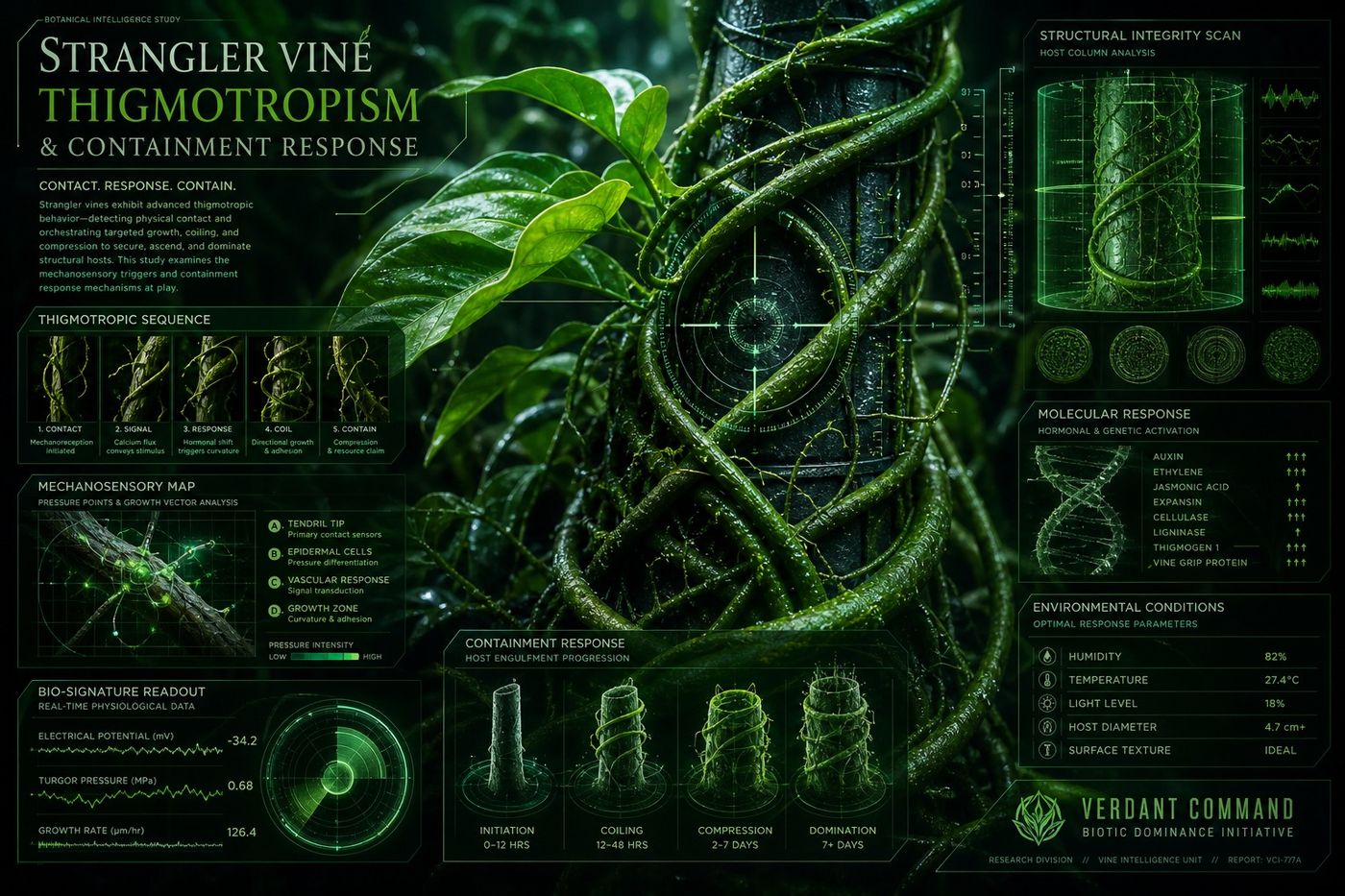
Objective
Quantify the thigmotropic response of cv. 'Garrote' to controlled mechanical stimulus: latency from contact to coil initiation, angular coiling rate, and peak sustained contractile pressure. Deliverable is a load envelope that the containment-fixture standard for GCL-3 motile specimens must exceed by the mandated safety factor, feeding directly into the Containment Integrity (VC-MET) metric.
Hypothesis
Coiling force in cv. 'Garrote' is not a fixed reflex but scales with both stimulus rigidity and stimulus motion: a rigid, moving contact will provoke a faster, harder coil than a compliant or static one. We hypothesize peak contractile pressure exceeds the previously assumed 180 kPa design basis for GCL-3 fixtures, and that repeated stimulus produces sensitization (each successive coil is faster), meaning a fixture rated for a single event is mis-rated for a containment breach in progress.
Method
- Subject: single mature cv. 'Garrote' lateral runner, instrumented in Bio-Vault 3, Cell C-2, behind GCL-3 glazing.
- Stimulus probe: force-instrumented dowel on a servo arm, presenting at controlled rigidity (compliant / rigid) and motion (static / 5 mm·s⁻¹ withdrawal).
- Contractile pressure read by an annular pressure cuff around the probe; coil angle by high-frame imaging from the Spectral Canopy Array.
- Aggression context logged against the facility Aggression Index; vault integrity against Containment Integrity.
- Hard stop: probe auto-retracts and CHLORA cuts stimulus if contractile pressure > 260 kPa or vault integrity flags. Handler abort authority absolute.
Bench Entries
Instrumentation verified against a dead control dowel; servo arm tracks to ±0.3 mm. First live contact, compliant/static probe. Coil initiation latency 2.4 s, peak pressure 118 kPa — within the old design basis, as expected for a lazy stimulus. The specimen treats a soft, still object as not worth the effort. Noted.
Rigid/static probe. Latency falls to 1.1 s, peak pressure 171 kPa. The specimen reads rigidity as a worthy anchor. Coil angle reaches 540° (1.5 wraps) before plateau. Still under the 180 kPa basis — but only just, and we have not added motion yet.
Rigid/moving probe (5 mm·s⁻¹ withdrawal — simulating a hand pulling away). Hypothesis confirmed and then some. Latency 0.6 s, and the coil chased the withdrawal. Peak contractile pressure 247 kPa — 37% over the 180 kPa GCL-3 design basis. Auto-retract armed at 260 but did not trip. The fixture standard is wrong. Anything that pulls away, it pursues. Logged a flag to Containment Engineering same hour.
Sensitization run: ten rigid/moving stimuli at 6-min spacing. Second hypothesis confirmed — latency dropped monotonically from 0.6 s to 0.31 s across the series; peak pressure rose to 271 kPa by trial 7 and tripped the 260 kPa auto-retract. Probe withdrawn, stimulus cut, no breach. The specimen learns within a session. A fixture rated for one event is rated for the wrong event. Aggression Index for Cell C-2 peaked at 84 during the run; vault integrity held nominal.
Recovery characterization. Sensitization decays with a half-life of ~41 min of no-stimulus rest; full reset by ~3 h. So a containment incident must be assumed to escalate for as long as contact continues. Sufficient data for the load-envelope deliverable. Specimen returned to baseline husbandry; vault sealed. I do not enjoy how attentive this one is.
Interim Findings
Contractile pressure is strongly modulated by stimulus rigidity and, decisively, by stimulus motion: a rigid object withdrawing provokes a pursuit-coil up to 247 kPa on first contact, rising to 271 kPa under within-session sensitization. The existing 180 kPa GCL-3 fixture basis is under-specified by up to 51%. Sensitization is real and persistent (~41 min half-life), so containment events must be modelled as escalating, not single-shot.
Next Steps
- Issue an engineering change request raising the GCL-3 motile-specimen fixture basis to ≥ 340 kPa (271 kPa × 1.25 safety factor).
- Recommend handling SOP forbid any moving withdrawal within the coil radius — present a static, compliant target instead.
- Cross-reference behaviour-modulation options with RL-2090-018 (Aggression Modulation) — chemical de-escalation may bound the load.
- Update the field-recovery posture for off-site strangler events via Operations.
References
- VC-SOP-0301 — Containment Discipline
- VC-SOP-0401 — Emergency Breach Response
- Containment Integrity metric
- Aggression Index metric
- Specimen Archive — cv. 'Garrote' provenance & recovery (FSR-2089-0442)
- Related log: RL-2090-018 — Carnivorous Specimen Aggression Modulation