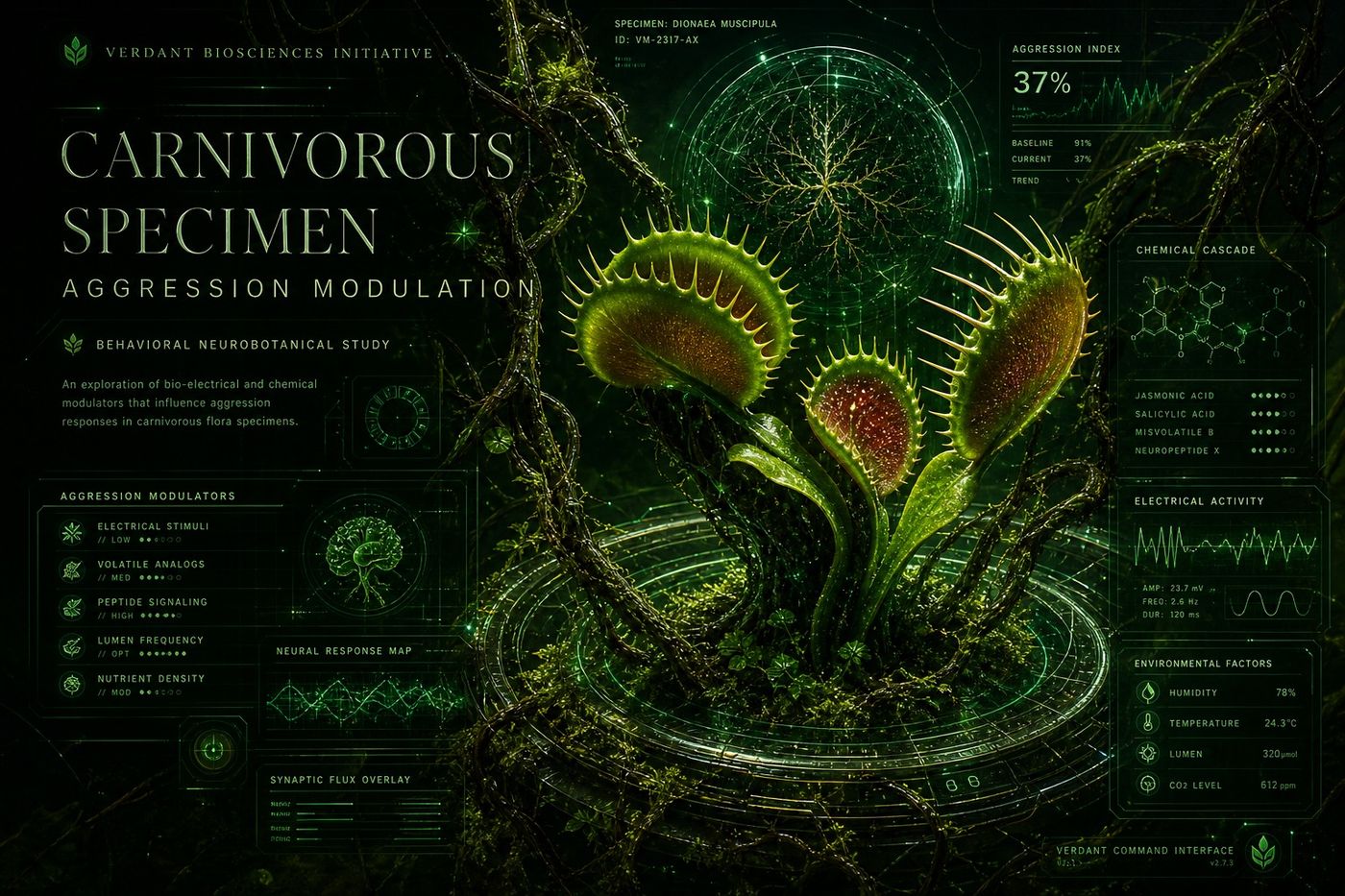
Carnivorous Specimen Aggression Modulation
RL-2090-018 — controlled de-escalation of trap-strike behaviour in Dionaea imperator 'Venus Sentinel' specimens via a reversible chemosensory dampening agent, to widen the safe-handling window without permanent sedation.
Objective
Identify a reversible intervention that lowers trap-strike probability and strike force enough to safely extend hands-on maintenance from the present 40-second handler window to ≥ 4 minutes, without inducing lasting sedation, trap necrosis, or loss of prey-capture function after washout. Outcome feeds the Aggression Index and the GCL-3 handling SOP.
Hypothesis
Trap-strike in 'Venus Sentinel' is gated by the trigger-hair action-potential threshold and the two-touch coincidence timer. We hypothesize that a nebulized, reversible calcium-channel dampening agent will raise the action-potential threshold — requiring more, harder touches to fire — thereby reducing accidental strikes during handling, and that the effect will wash out within one irrigation cycle leaving capture function intact. Risk: over-dampening could suppress the trap permanently or starve the specimen.
Method
- Cohort: 6 mature 'Venus Sentinel' specimens, Bio-Vault 2 Sentinel Bay, individually instrumented traps.
- Agent delivered by nebulized mist at three doses — none, low, standard — 10 min pre-handling.
- Strike metrics: touches-to-fire, closure latency, and clamp force (instrumented dummy prey); behaviour scored against the Aggression Index.
- Reversibility: capture-function retest at 1, 3, and 6 irrigation cycles post-dose.
- Hard limits: any trap failing to reopen within 12 h, or any specimen missing two consecutive feeds, ends that arm. Handler abort authority absolute.
Bench Entries
Baseline. Untreated traps fire on 2 touches within 1.4 s; closure latency 0.31 s; clamp force 4.6 N; Aggression Index for the bay sits at 71. Handler window before a strike risk is unacceptably short — ~40 s of exposed contact. This is why Sentinel maintenance is a two-person, fast-hands job. Establishing the dose arms.
Low dose. Touches-to-fire rises to 3, closure latency to 0.52 s, clamp force eased to 3.9 N. Aggression Index down to 58. Handler window roughly doubles to ~90 s. Traps still feed normally on live offering — the dampening is partial, the specimen is calmer but not disarmed. Encouraging and, importantly, the trap still works.
Standard dose. Strike suppression strong — touches-to-fire 5+, clamp force 2.1 N, Aggression Index 39, handler window comfortably past 4 min. But: specimen S-3 failed to reopen a closed trap for 14 h, exceeding the 12 h limit, and skipped its feed. Standard-dose arm halted on S-3. Over-dampening is real at the top dose. No injury, no escape; the specimen recovered full function 2 cycles after washout. The lesson is the dose, not the agent.
Reversibility characterization on the Low and an interpolated Low-plus dose. Low-plus gives touches-to-fire 4, clamp force 3.1 N, handler window ~3.5 min, Aggression Index 47 — and full capture function restored within 1 irrigation cycle of washout across all 6 specimens, no missed feeds. This is the operating point. Standard dose remains off-limits for routine use.
Confirmation runs at Low-plus over 6 weeks of routine maintenance: zero accidental strikes, zero missed feeds, full reversibility every cycle. The handling window is now adequate and the specimens lose nothing. They simply become, briefly, less interested in the hand that tends them. Sufficient for the deliverable; reporting interim and recommending the SOP amendment.
Interim Findings
The action-potential-threshold hypothesis is confirmed: a nebulized reversible calcium-channel dampening agent raises touches-to-fire and softens clamp force in a dose-dependent way. The standard dose over-dampens (trap fails to reopen, feed missed — an unacceptable welfare and function loss), but an interpolated Low-plus dose safely extends the handler window from ~40 s to ~3.5 min with full reversibility within one irrigation cycle and no missed feeds. Capture function is preserved; the effect is a temporary disinterest, not a disabling.
Next Steps
- Draft amendment to VC-SOP-0301 adding the Low-plus pre-handling protocol for Sentinel-class maintenance.
- Define an explicit dose ceiling and the reopen-within-12 h welfare interlock in the SOP.
- Coordinate with RL-2091-009 on whether the same chemosensory dampening bounds strangler-vine contractile escalation.
- Log the over-dampening failure mode (S-3) to the Specimen Archive welfare record.
References
- VC-SOP-0301 — Containment Discipline
- VC-SOP-0401 — Emergency Breach Response
- Aggression Index metric
- Specimen Archive — 'Venus Sentinel' cohort welfare record
- Related log: RL-2091-009 — Strangler Vine Thigmotropism & Containment Response