Soporific Volatile Containment & Scrubbing
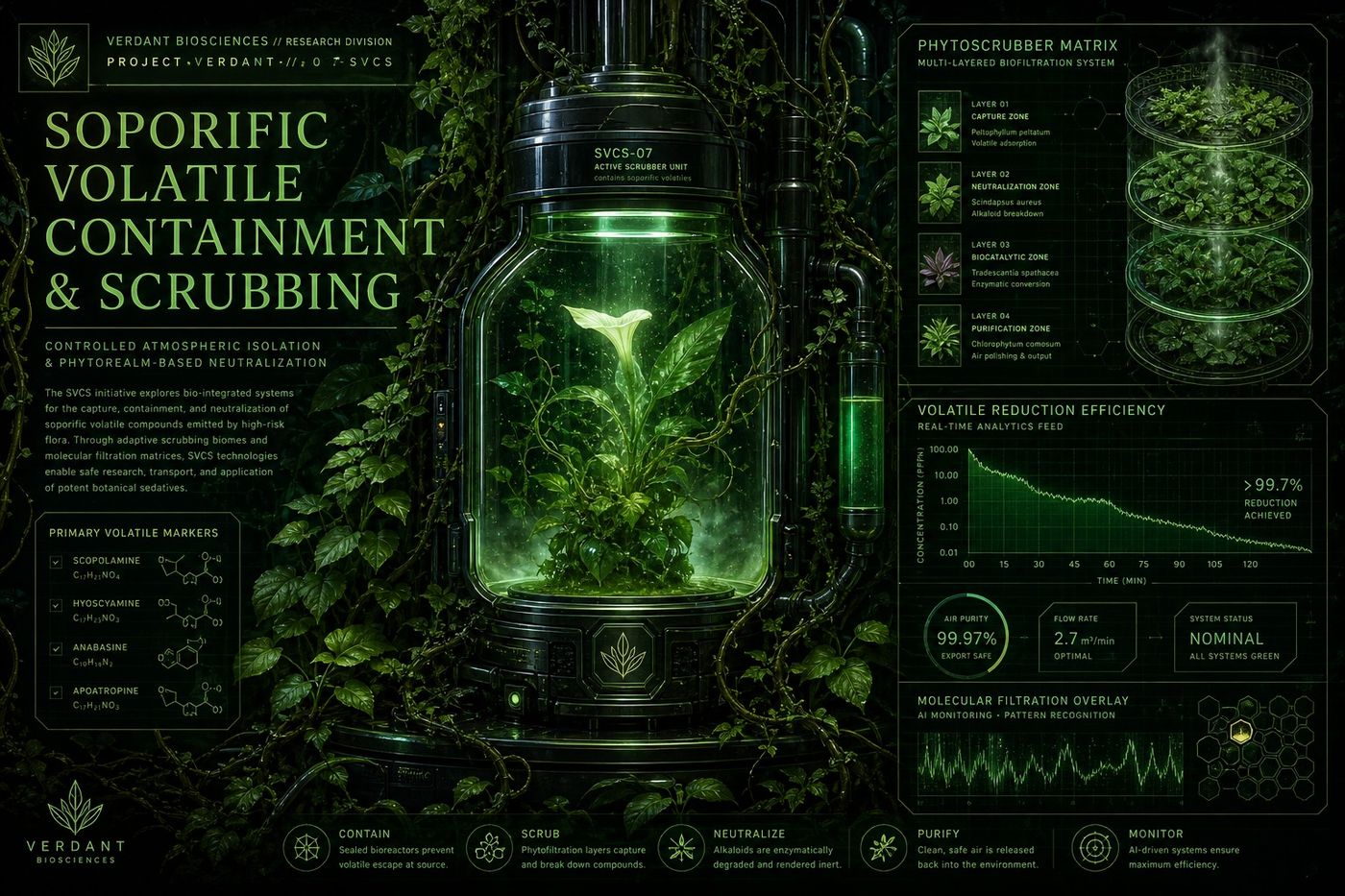
RL-2091-040 — characterizing emission and capture of the airborne sedative volatile from Somnus narcoticum bloom, and qualifying a scrubber train that holds personnel exposure below the action limit in the Dream Conservatory.
Objective
Quantify peak and time-averaged airborne concentration of the target soporific volatile (designated VC-SOM-1) during S. narcoticum bloom, and qualify a two-stage scrubber train that holds the 8-hour time-weighted personnel exposure below the established action limit of 0.05 ppm, with a short-term excursion ceiling of 0.20 ppm. Feeds the conservatory ventilation standard and the breach-response posture in VC-SOP-0401.
Hypothesis
VC-SOM-1 emission is bloom-phase coupled — released in a sharp pulse at anthesis, not continuously — so a fixed-rate scrubber will be over-sized most of the day and under-sized at the peak. We hypothesize that a bloom-phase-predictive, demand-modulated scrubber (CHLORA stepping fan speed and sorbent contact on a fluorescence anthesis cue) will hold exposure below the action limit at far lower mean energy than constant maximum extraction, and that a single sorbent stage will saturate within one bloom cycle without a regenerating polish stage.
Method
- Source: S. narcoticum bloom bench, Dream Conservatory Cell D-1, sealed and negatively pressurized.
- Scrubber train: Stage 1 activated-carbon sorbent; Stage 2 regenerable cold-trap polish; demand fan 0–100%.
- Air monitoring: photoionization detectors at bench, breathing-zone, and stack, 30-s cadence, logged to the Mycelial Data Fabric.
- Two control modes: Constant (fan 100%, sorbent only) vs Predictive (anthesis-cued modulation + cold-trap polish).
- All entries below the action limit; any breathing-zone reading > 0.20 ppm triggers cell lockout and respirator protocol per VC-SOP-0401.
Bench Entries
Emission profiling, no scrubbing (sealed cell, no personnel). Hypothesis visible immediately: VC-SOM-1 is near-zero for ~20 h, then spikes to 1.9 ppm at anthesis over a 40-min window. It is a pulse, not a plume. A constant scrubber would idle through the quiet and then meet the spike already behind. The bloom keeps a schedule; the scrubber must learn it.
Constant mode (fan 100%, Stage-1 carbon only). Peak breathing-zone held to 0.11 ppm, 8 h TWA 0.018 ppm — under the action limit. But the carbon sorbent broke through on the third bloom cycle: outlet climbed to 0.07 ppm as the bed saturated. Single-stage sorbent is a consumable, not a control. Confirms the need for the regenerating polish.
Setback. During a constant-mode bed changeout, a maintenance tech entered the cell on a stale air clearance and recorded a transient breathing-zone reading of 0.23 ppm — over the 0.20 ppm short-term ceiling. Tech reported drowsiness, was withdrawn, observed, fully recovered within 25 min, no lasting effect. Recordable exposure event; escalated per VC-SOP-0401. Root cause: clearance interlock did not account for residual desorption from a loaded bed. The bed exhales what it inhaled. Interlock logic flagged for redesign.
Predictive mode commissioned with cold-trap polish and a desorption-aware clearance interlock. Anthesis cued off Stage-II fluorescence ~30 min ahead of the spike; fan ramps pre-emptively. Peak breathing-zone 0.06 ppm, 8 h TWA 0.009 ppm, no sorbent breakthrough across 9 cycles (cold trap regenerates each quiet phase). Mean fan energy down 54% vs constant. Both hypotheses confirmed.
Confirmation run, 9 consecutive bloom cycles in Predictive mode. Action limit never approached in the breathing zone; the lone risk window is changeout/maintenance, now governed by the desorption-aware interlock. Reporting interim, recommending Predictive mode as the conservatory standard, and forwarding the interlock fix as a safety-critical change.
Interim Findings
VC-SOM-1 is confirmed a bloom-phase pulse (~1.9 ppm at anthesis over 40 min, near-zero otherwise). Constant single-stage scrubbing meets the limit but saturates by the third cycle and leaves a residual-desorption hazard at changeout — the cause of a recordable 0.23 ppm exposure event. The predictive demand-modulated train with a regenerating cold-trap polish holds the 8 h TWA to 0.009 ppm (5.5× margin), eliminates breakthrough across 9 cycles, and cuts fan energy 54%. The residual hazard is now the maintenance window, addressed by a desorption-aware clearance interlock.
Next Steps
- Adopt Predictive mode + cold-trap polish as the Dream Conservatory ventilation standard.
- Implement the desorption-aware clearance interlock as a safety-critical change; re-train maintenance on bed-changeout clearance.
- File the 0.23 ppm exposure event after-action per VC-SOP-0401 and close the corrective action.
- Reference VC-SOM-1 exposure limits into the extraction handling of RL-2090-022 where soporific co-fractions occur.
References
- VC-SOP-0401 — Emergency Breach Response
- VC-SOP-0221 — Toxin Extraction (volatile handling)
- Botanical Metrics Library
- Specimen Archive — Somnus narcoticum emission record
- Related log: RL-2090-022 — Alkaloid Extraction Efficiency